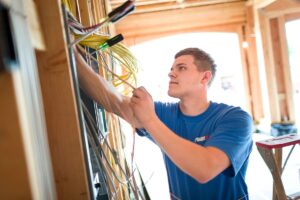
Becoming an electrician is a strong career choice for people who want stability, good pay, and long-term demand. Electricians are needed in residential homes, commercial buildings, manufacturing facilities, utilities, and infrastructure projects, and that demand isn’t going away.
However, it’s important to be very clear up front: Washington and Oregon are widely considered the two hardest states in the country to become a licensed electrician. The path is structured, competitive, and slow by design. This isn’t meant to discourage anyone, but to help you understand the reality before you invest years of your life into the process.
If you plan early and approach it the right way, the career can be extremely rewarding.
What the Electrician Career Really Involves
Electricians do far more than pull wire and install outlets. The job requires:
- Strong problem-solving and troubleshooting skills
- Comfort with math, electrical theory, and technical systems
- Physical stamina and the ability to work in demanding environments
- Strict attention to safety rules and electrical code
This is not a trade you can casually try out. In both Washington and Oregon, every licensed electrician must complete a formal apprenticeship program. There is no longer an option to work independently and “test out” later. That pathway has been eliminated.
Why Washington and Oregon Are So Difficult
Many people are surprised by how competitive the process is. It often takes one to three years just to get accepted into an apprenticeship. Applications are point-based and highly competitive. Grades matter and math is mandatory, not optional.
Minimum requirements include:
- High school diploma or GED
- Minimum 2.0 GPA (higher GPAs earn more points)
- One full year of algebra with a C or better
- Valid driver’s license
Even meeting the minimum requirements does not guarantee acceptance. The better your grades, especially in math, the stronger your application will be. If you’re still in high school, planning early can make a massive difference. Prairie Electric strongly encourages students to enroll in Cascadia Technical Academy, which provides direct entry into an apprenticeship program.
Apprenticeships: The Only Path Forward
All electricians in Oregon and Washington must complete an approved apprenticeship before they can become licensed. There are no exceptions.
Prairie Electric is a training agent and active member of JATC Area 1 (Oregon) and EMGOW (Washington).
These programs coordinate classroom education, on-the-job training, and licensing eligibility. They also reciprocate across state lines, which is especially important for electricians working near the Oregon–Washington border.
Apprenticeship Requirements
To complete an apprenticeship, you must log:
- 8,000 hours of supervised on-the-job training
- 576 hours of classroom instruction
During this time, apprentices earn progressive wage increases as their skills and responsibilities grow. Prairie Electric covers all apprenticeship-related costs, including tuition, books, required classes and tools. This represents a significant investment per apprentice, which is why the selection process is selective and competitive.
Understanding Electrician License Types
Not all electrician licenses allow you to do the same work. This distinction affects hiring, job assignments, and long-term career flexibility.
Washington Electrician Licenses
01 Electrician (General Journey Level)
- Full-scope license
- Can perform residential, commercial, and industrial electrical work
02 Electrician (Residential Specialty)
- Limited scope
- Typically restricted to basic residential work in single-family homes
Because Prairie Electric performs work across residential, commercial, and industrial environments, 01 electricians are strongly preferred. They can be sent to any job site without restrictions, which simplifies scheduling and compliance.
Oregon Electrician Licenses
General Journeyman Electrician (J)
- Full-scope license
- Comparable to Washington’s 01
Residential Journeyman Electrician (R)
- Limited to residential electrical work
- Comparable to Washington’s 02
Master and Supervising Electricians
These roles focus on oversight, not daily field labor.
- Washington: Master Electrician
- Oregon: Supervising Electrician
They are responsible for supervising other electricians and interpreting and enforcing electrical code. They oversee permits, inspections, and system design to ensure overall project compliance. They typically do not perform routine hands-on installation work.
Completing the Apprenticeship
While working as an apprentice, you’ll learn:
- Electrical theory and systems
- Code-compliant wiring methods
- Blueprint and schematic reading
- Troubleshooting and diagnostics
- Job-site safety and compliance
Apprentices must maintain strict ratios with licensed journeymen, which limits how many apprentices can be placed at once and adds another layer of competitiveness.
Licensing Exams in Oregon and Washington
After completing your required hours and coursework, you can apply to test.
- Oregon: Oregon State Journeyman Electrician Exam
- Washington: Washington State Electrical License Exam
Many electricians test for both states, especially when working in the Portland–Vancouver region. When you go through the approved apprenticeship programs, dual-state testing is common.
Reciprocity: What Transfers and What Doesn’t
Electrician licenses do not automatically transfer between states.
- Washington only reciprocates with Oregon.
- Oregon reciprocates with: Arkansas, Idaho, Maine, Montana, Utah, Wyoming, and Washington.
If you are licensed in another state, you may still be required to document hours, complete additional training, and pass state-specific exams.
Washington’s out-of-state process can be reviewed here. Oregon’s reciprocity information is here.
Becoming an electrician in Oregon or Washington is not fast and not easy. These states have some of the strictest licensing laws in the country. The apprenticeship programs are highly competitive and facing increasing regulation and oversight. But for those who commit early, take school seriously, and understand the process, it can lead to a stable, well-paying, and respected career. That’s why Prairie Electric spends significant time working with schools, counselors, and training programs to make sure students, parents, and applicants understand the path before they apply.